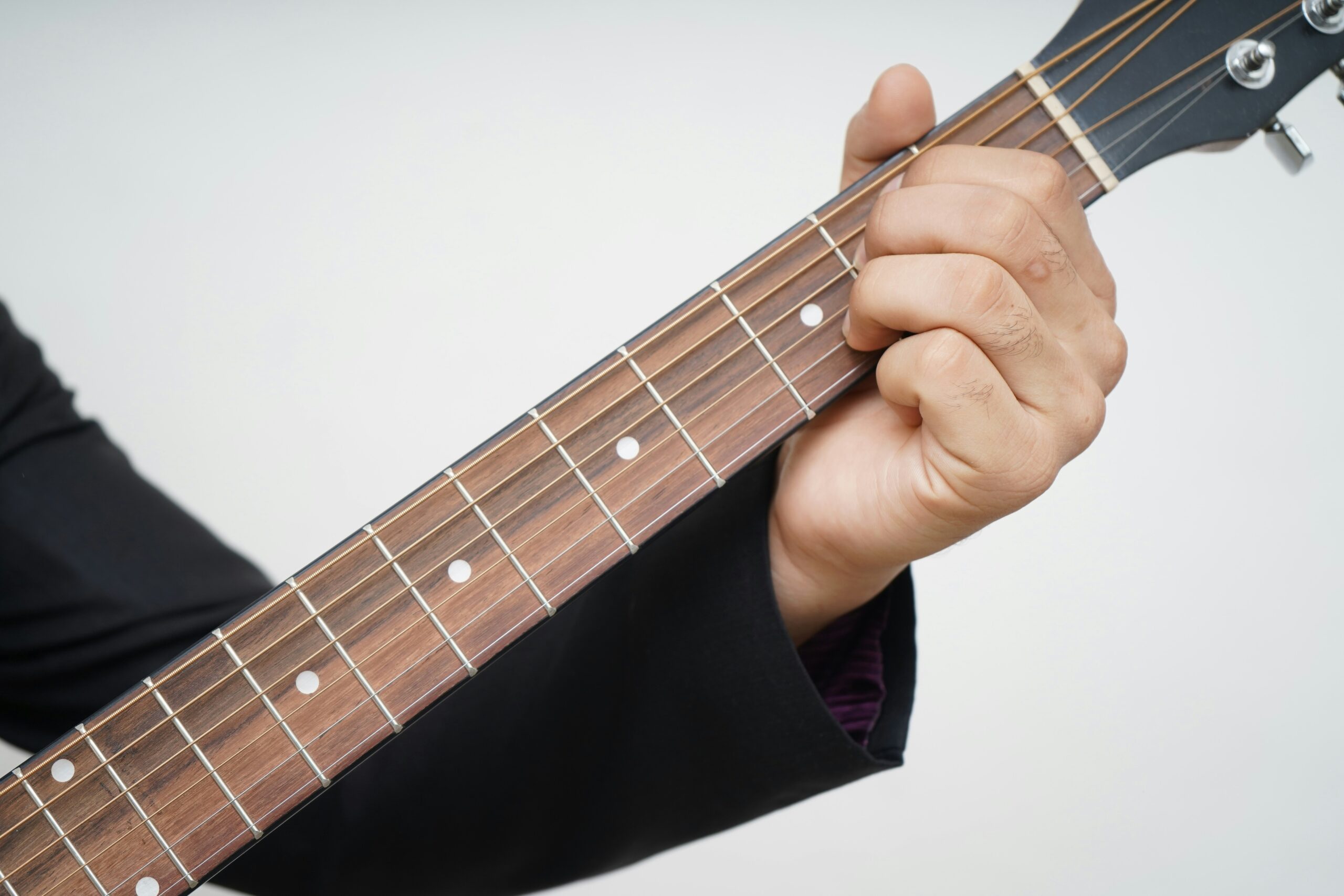
Introducing 7th Chords on Guitar
Seventh chords are an essential part of any guitarist’s toolkit, offering a wider range of emotional and harmonic depth compared to simple triads. Whether you are delving into jazz, blues, rock, or classical, understanding the different qualities of 7th chords and how they function in music will open up new expressive possibilities on the guitar. If you’re comfortable reading tab and/or sheet music, dive into the PDF below!
Check out more concepts and exercises in my Free Sheet Music Library!
7th Chord Qualities
In this article, we’ll explore the five main types of 7th chords—major 7th, dominant 7th, minor 7th, minor 7th flat 5, and diminished 7th—and how they contribute to the harmonic landscape. The attached PDF provides moveable chord shapes for each of these chords, with examples using roots on both the E and A strings, making it easy to transpose these shapes to different keys.
1. Major 7th Chords
Major 7th chords add a warm, lush quality to the typical major triad. Composed of a root, major third, perfect fifth, and major seventh, these chords have a dreamy, resolved sound that’s often used in jazz, ballads, and sophisticated pop music. While a standard major chord gives a simple, happy sound, the major 7th adds a touch of sophistication and openness.
2. Dominant 7th Chords
Dominant 7th chords are perhaps the most common type of 7th chord. Built from a root, major third, perfect fifth, and minor seventh, dominant 7th chords are foundational in creating tension that seeks resolution. This tension is what makes the dominant 7th chord essential in blues, rock, and jazz, where the V7 chord resolves back to the tonic (I).
For instance, in a G7 chord, the addition of the minor seventh (F) to the G major triad creates a sense of urgency, making it perfect for cadences and resolutions.
3. Minor 7th Chords
A minor 7th chord is a minor triad (root, minor third, perfect fifth) with the addition of a minor seventh. These chords are darker and more introspective than their major counterparts, often used to create moody or soulful progressions. They are especially prominent in jazz and R&B but can be found in many genres.
In a chord like Am7, the minor seventh (G) adds a layer of depth and subtle tension to the basic A minor triad, enriching the harmonic palette without creating as much tension as a dominant 7th chord.
4. Minor 7th Flat 5 (Half-Diminished) Chords
The minor 7th flat 5 chord, also called the half-diminished chord, adds a diminished fifth to the minor 7th structure. This chord is built from a root, minor third, diminished fifth, and minor seventh. It’s commonly used in jazz and classical music to create smooth transitions, particularly in minor key ii-V-I progressions.
For example, in a Bm7♭5 chord, the diminished fifth (F) gives the chord a somewhat unstable feeling, preparing it to resolve smoothly to a more stable chord like E7 or Am. Its unique sound is perfect for creating tension that doesn’t overpower the progression.
5. Diminished 7th Chords
Diminished 7th chords are built from a root, minor third, diminished fifth, and diminished seventh. These chords are symmetrical, meaning that the intervals between each note are identical, which gives them a tense, unresolved sound. They are often used to modulate between keys or to create dramatic tension in a piece of music.
A diminished 7th chord like Edim7 features a diminished seventh (D♭) that adds an additional layer of dissonance, making it feel as though the chord is always pulling toward resolution. In many cases, diminished 7th chords are used as passing chords or in cadences to create striking harmonic shifts.
Moveable Shapes and Transposition
The attached PDF contains moveable shapes for each type of 7th chord, with examples on both the E and A strings. These shapes are designed to make it easy to transpose chords to different keys, providing flexibility across the fretboard. By learning the shapes for major 7th, dominant 7th, minor 7th, minor 7th flat 5, and diminished 7th chords, you’ll be equipped to play these chords in any key, unlocking a new level of harmonic sophistication in your playing.
Conclusion
Seventh chords are a crucial part of building harmonic depth in music, offering a wide range of emotional textures and sonic possibilities. By learning the various types of 7th chords and practicing them using moveable shapes on the guitar, you will enhance your ability to navigate different genres, improvise with more confidence, and compose more complex harmonic progressions. Happy practicing!
Comments are closed