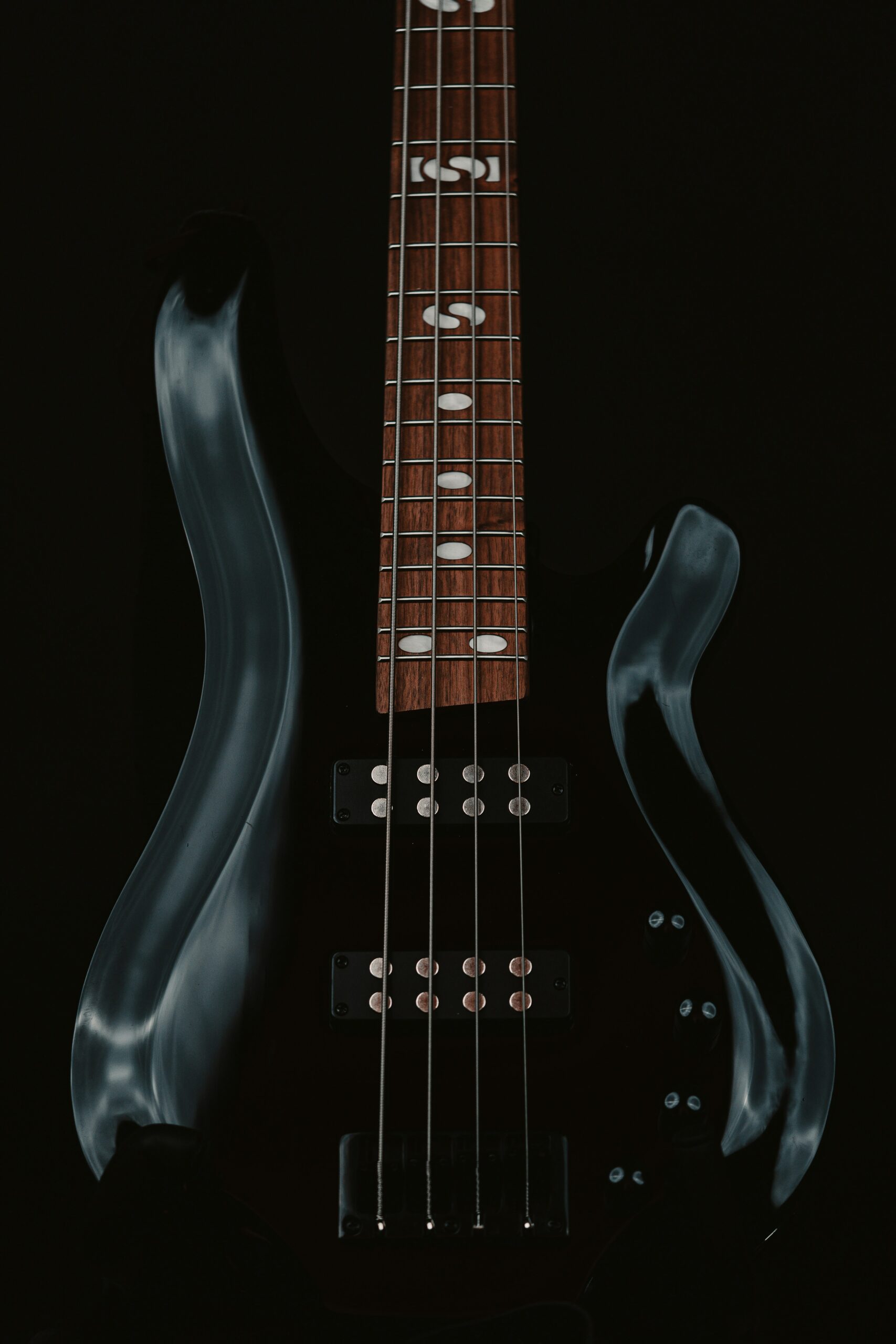
Reading Sheet Music for Bass Guitar
Reading bass guitar notation is an essential skill for any aspiring bassist. Understanding how to read music will open up a world of possibilities, allowing you to play a wide range of songs and styles with confidence. This guide will cover the basics of bass guitar notation, including string numbers, tuning, the transposing nature of the bass, the notes on the bass clef, and note values.
Check out more exercises and concepts in my Free Sheet Music Library!
Notes on the Bass Clef
The bass clef, also known as the F clef, is used for bass guitar notation. The lines and spaces on the bass clef represent different notes:
Line Notes
- G (1st line)
- B (2nd line)
- D (3rd line)
- F (4th line)
- A (5th line)
Space Notes
- A (1st space)
- C (2nd space)
- E (3rd space)
- G (4th space)
Understanding Note Values
In addition to knowing the notes on the bass clef, it is essential to understand note values, which indicate the duration of each note. Here are the most common note values you will encounter:
Whole Note: a whole note is sustained for 4 beats. You can see an example of one in the 2nd measure of the sheet music above. The example shows an ‘A’ note sustained for 4 beats. This means you would play an A on the bass and count 4 beats. Whole notes are sometimes called “goose eggs” because they are oval shaped like an egg!
Half Note: a half note is sustained for 2 beats.
Quarter Note: a quarter note is sustained for 1 beat. You can see an example of one in the 3rd measure of the sheet music above (the measure with “The Open Strings” written above it). 4 quarter notes can fit in a measure of 4/4 time. 4/4 time means that each measure has 4 beats.
Eighth Note: an eighth note is sustained for 1/2 of a beat. You can see eighth notes in the first measure of the music above. The first measure contains 8 eighth notes. Eighth notes get their name from the fact that you can fit eight of them into a measure of 4/4 time. You can count eighth notes like this: 1 ‘and’ 2 ‘and’ 3 ‘and’ 4 ‘and’. This way, you are counting the beats and the eighth notes that come in between the beats.
Understanding these note values is crucial for reading rhythm accurately and playing in time with other musicians.
Understanding String Numbers and Tuning
The standard bass guitar has four strings, numbered from the lowest (thickest) to the highest (thinnest):
- 4th String (E)
- 3rd String (A)
- 2nd String (D)
- 1st String (G)
This is considered standard tuning for bass guitar.
Remembering the Open Strings
A helpful mnemonic device for remembering the open strings of the bass guitar is:
- E: Eddie
- A: Ate
- D: Dynamite
- G: Goodbye!
Using this, you can quickly recall the tuning of the strings: E, A, D, and G.
Bass as a Transposing Instrument
The bass guitar is a transposing instrument, meaning the notes you read in the bass clef are played an octave lower than written. This is crucial to understand, especially when playing with other instruments, as it ensures you produce the correct pitch.
Putting It All Together
When you see a note written on the third line of the bass clef, you know it is a D. Additionally, you need to pay attention to the note value to play it for the correct duration. A quarter note D on the third line of the bass clef means you will play a D note on your bass guitar for one beat.
To practice reading bass notation, start with simple bass lines and gradually move on to more complex pieces. Here are a few tips:
- Learn the Notes: Familiarize yourself with the notes on the bass clef and their corresponding positions on the bass guitar. There are lots of helpful ways out there to memorize the line and space notes.
- Practice Regularly: Consistent practice will help reinforce your knowledge and improve your ability to read and play music.
- Use a Metronome: Practicing with a metronome can help you maintain a steady tempo and improve your timing.
- Play Along with Recordings: Listening to and playing along with recordings can help you understand how the notation translates to real music.
Conclusion
Reading bass guitar notation is a valuable skill as a bassist. By understanding string numbers, tuning, the transposing nature of the bass, the notes on the bass clef, and note values, you’ll be well on your way to mastering this essential aspect of bass playing. Remember to practice regularly, and soon you’ll find yourself reading and playing bass guitar music with ease. Happy practicing!
Comments are closed